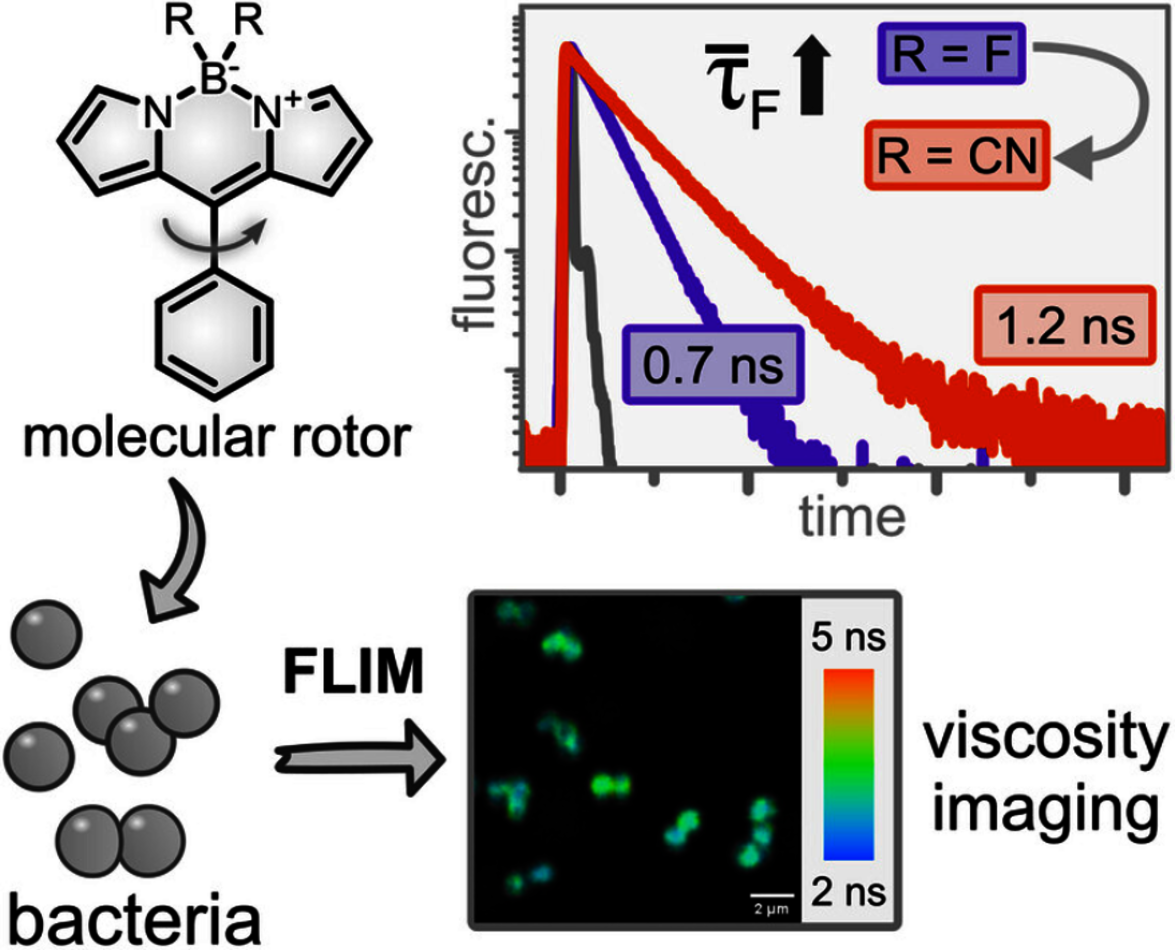

Yelyzaveta Denysieva and Dmytro Dziuba, together with Ludovic Richert and Yves Mély from the BIMC team and Julie Karpenko from the LIT, have recently published a study on the development of improved fluorescent probes for fluorescence lifetime imaging microscopy (FLIM).
The team investigated BODIPY-based fluorescent molecular rotors, a class of viscosity-sensitive fluorescent probes that can be used to measure the properties of their local microenvironment. The study shows that a simple chemical modification – replacing fluorine atoms with cyano groups – substantially improves the photophysical properties of these probes, resulting in significantly longer fluorescence lifetimes.
Longer fluorescence lifetimes can be particularly advantageous for FLIM measurements, as they provide better temporal separation between the probe signal and short-lived background fluorescence. This can facilitate the detection of fluorescence in environments with relatively low viscosity, where molecular rotors normally exhibit short lifetimes.
Key findings include:
- Fluorescence lifetimes increased by up to 1.6 ns compared with the corresponding fluorinated BODIPY rotors.
- The modified probes retain good sensitivity to viscosity while providing an extended lifetime range.
- The cyano-substituted rotors show reduced aggregation in aqueous media.
- A membrane-targeting probe was developed and successfully applied to estimate the apparent microviscosity of the plasma membrane in living bacterial cells.
Overall, this work demonstrates how a small structural modification can significantly improve the performance of molecular rotors for FLIM. The findings provide a promising strategy for developing fluorescent probes with extended lifetime responses for studying cellular microenvironments and membrane properties.
Congratulations to the authors !
Link : doi.org/10.1002/chem.71693