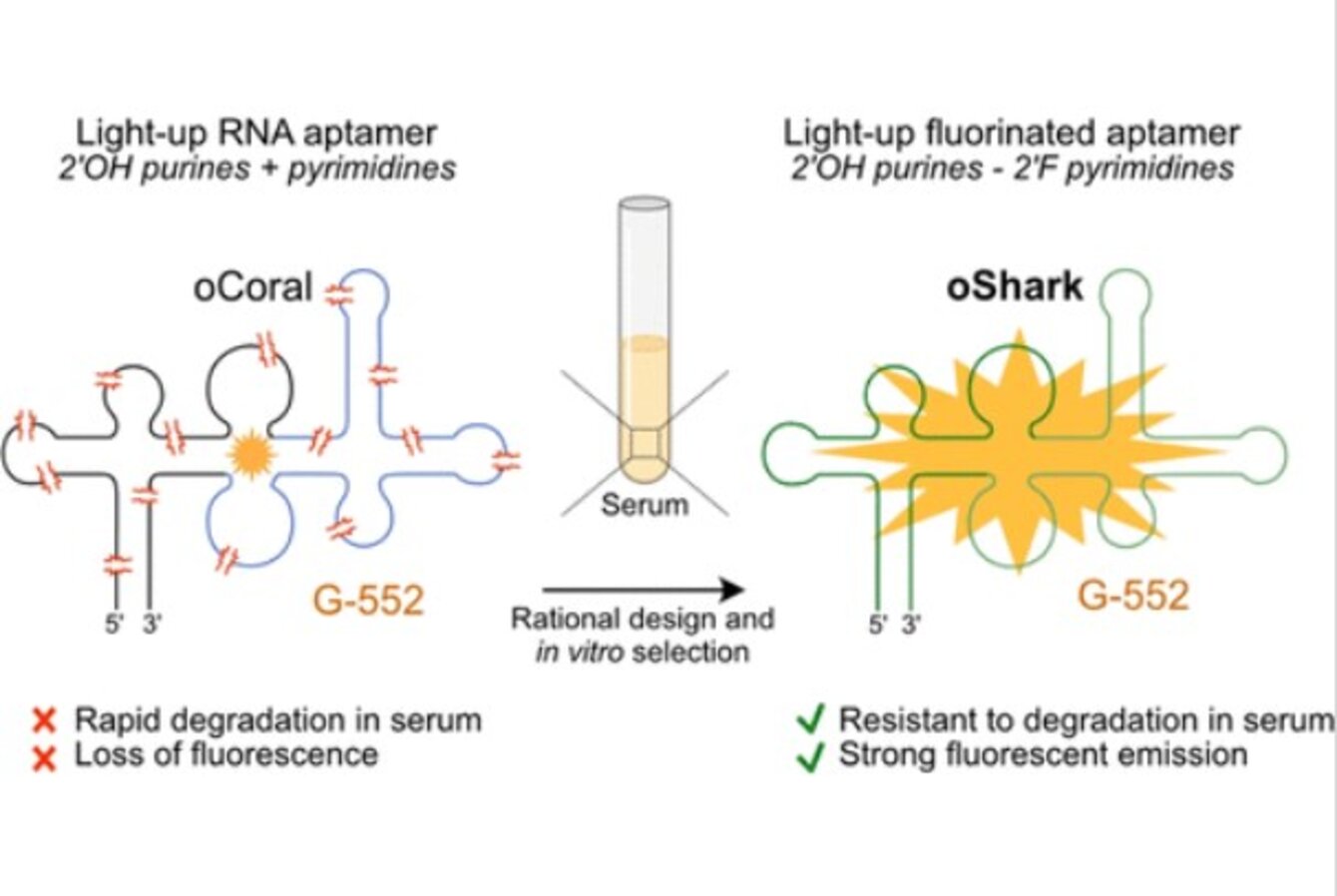

A collaborative work of Tanushree Gupta and Andrey Klymchenko with Michael Ryckelynck, Janine KEHRLI and Roger Cubí Piqué from UPR9002-IBMC, Strasbourg, resulted in oShark, a chemically modified light-up aptamer designed to resist degradation in complex biological environments, which is now published in the Journal of the American Chemical Society (JACS).
Background: Light-up RNA aptamers are RNAs that adopt a specific 3D structure allowing them to bind to a fluorogen and activate its fluorescence. They are powerful tools for molecular tracking, imaging, and targeted detection. However, their use in extracellular environments remains limited by the low chemical stability of RNA, which degrades rapidly.
The two teams combined a directed evolution strategy with microfluidic-assisted screening and rational sequence optimization to develop oShark, a fluorinated aptamer capable of activating the Gemini-552 fluorogen while maintaining its structure and function even under demanding biological conditions.
They showed that:
- The selected mutations enable the fluorinated aptamer to regain optimal folding, comparable to its unmodified precursor oCoral.
- oShark exhibits increased stability and a level of fluorescence equivalent to the original aptamers.
- By merging oShark with Mango-II and optimizing the binding sequence, they designed Lemon-oShark, the first double-fluorescent modified aptamer.
Congratulations to all the authors, as oShark and Lemon-oShark pave the way for new imaging and detection tools in complex environments, particularly for applications where RNA stability is essential.
Link : https://doi.org/10.1021/jacs.5c14653